
The Dog Crate Training Game
By Jean Cote | Posts , Training , Tricks
 Dog crate training doesn’t have to be an overwhelming or even frustrating task. When you use the right methods, you can successfully crate train your dog without using force or punishment.
The first step to crate train your dog is to create a positive association with his crate. This will help your dog to learn that his crate is a place of rest and comfort, not a place intended for punishment.
Conditioning Using Treats & A Clicker
Instead of throwing your dog into a crate to let him get used to his new environment, use a clicker with reward-based training to help your dog acclimate and make a positive association with his crate.
This is a truly smart way to approach dog crate training; you will lure the dog into the crate with delicious treats. Once your dog goes into the crate willingly to receive the treats, you can use the sound of a clicker to reinforce the action and encourage good behavior.
- Place a handful of treats in the crate with the door open.
- Wait for your dog to notice the treats and enter the crate to eat the treats.
- As soon as your dog goes into the crate, click the clicker to mark the behavior and give him another treat. (You can let him eat the treats that are in the crate. Eventually your dog will understand that getting into the crate is the behavior that earns him the treat.)
- Leave the crate door open so that your dog can come and go as he pleases. Each time that he enters the crate to get another treat, click the clicker & give him a treat to reinforce the behavior.
- Continue this activity for several days until your dog becomes comfortable with the crate.
- The next time that your dog goes into the crate, close and open the door. That will get him used to seeing the door behind him. Always give him a treat to keep this a positive association.
- After closing the door for a moment, let the dog out immediately.
- After several days of this activity, increase the amount of time that the door is closed, starting from 30 seconds up to 2 – 5 minutes. You can give your dog some treats through the door while he is in the crate so that he associates pleasure with the treat.
- The next step will be for you to step away from the crate. Place your dog in the crate and walk away, then turn back and give your dog a treat. You can do this a few times in a row, but don’t leave him in there yet.
- In the last exercise, you will combine the amount of time he is in the crate with the door closed and also with you walking away (to another room). Gradually increase the time that your dog is in the crate before rewarding. When letting your dog out of the crate, make it fun by going outside or for a walk.
This is by far the most effective method in dog crate training to use to reinforce a positive association with a crate. Instead of feeling like you are locking your dog in a crate for hours at a time as a form of punishment when you leave the house, your dog will start to see dog crate training as a game.
When this method is used properly, your dog will love spending time in his crate – believe it or not. After this method has been used for successful dog crate training, you can leave the door of the crate open all day long so that your dog can enter as he pleases. You may find that your dog will enjoy resting and taking a nap inside of the crate because he feels comfortable, safe, and protected.
Once this happens, you will know that you have used dog crate training successfully! The entire point of a crate is to give your dog a safe, restricted area to spend time in whenever you leave the house. This will set clear boundaries for your dog so that he feels secure and is not anxious about doing something wrong and getting punished.
 Taking your dog for a walk on a leash shouldn’t mean that your dog is pulling you down the block! Proper leash training will make walking your dog on a day-to-day basis a pleasant experience. As your dog learns how to walk obediently on a leash, he will remain by your side at all times without any tension or pulling.
 Nonstop dog barking is enough to drive any pet owner insane. If you’re at the end of your rope and can’t seem to stop your dog from barking any time that he meets a new person or that the doorbell rings, it may be time to consider how to stop dog barking using technology.
 According to the American Veterinary Society of Animal Behavior, punishment should not be used as a primary approach to dog training.1 When an animal is punished, it indicates that the dog knew exactly what was expected of him and disobeyed on purpose. But in most cases, dogs are simply confused and have not been given the proper reinforcement to behave well in the first place.
 The ultimate goal of crate training should be to provide your dog with a safe, cozy, and content environment that they can go to throughout the day and to sleep in at night. Once you acclimate your dog through crate training, it will also make it easier to travel and transport your dog to the groomer or the vet.
 What is Clicker Training? Simply put, clicker training is an easy and effective animal training method that has become popular over the past ten years because of its gentle approach. Clicker training is also often referred to by its scientific name: operant conditioning.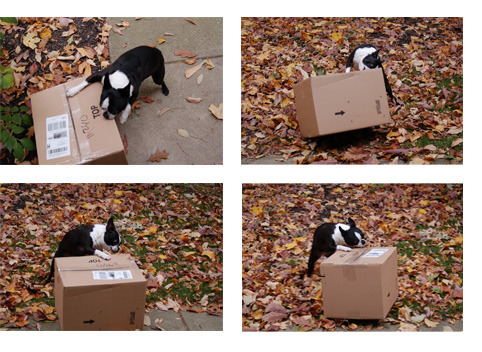

 When you talk to another person in day-to-day life, you pick up on hundreds of body language cues without even realizing it. But did you know that your dog gives off the same cues regarding their temperament, mood, and behavior by using their body language?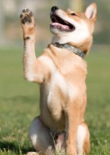
 Bringing a puppy home for the first time is a fun and exciting occasion. That is, until reality sets in, and you realize that you have quite a bit of work on your hands when it comes to house training and stopping a brand-new puppy from chewing and barking.
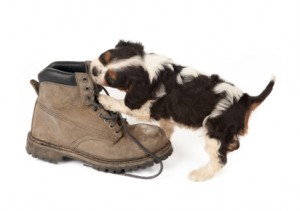 Chewing: If your puppy is playful and spends time playing with its new toys, you can use that opportunity to reinforce. Give a treat and lots of praise and petting to show your puppy that its good behavior has been rewarded.
 Housetraining: The only way to stop a puppy from soiling in the house is to catch it in the act. This is then the opportunity to punish by startling the puppy in the same way with an “AHH!” word and then take it outside. Once the puppy successfully uses the toilet outside, it should be rewarded with a treat, praise, and petting each time.
 Teaching your dog new tricks might not be the easiest thing in the world, but it’s highly beneficial to you and your dog. Teaching your dog new tricks can help strengthen your relationship with your beloved pet in many ways. Below are some great reasons why you should start teaching your dog new tricks.