
Menu
Choosing the Right Dog Training Classes
By Sally Gutteridge | Posts
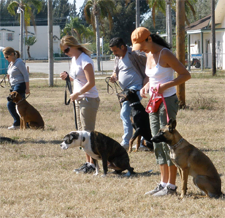 Are you looking for dog training classes? Before you spend a dime I encourage you to read more about the different dog training classes available today. Choosing a dog training class is a very important decision that will affect your relationship with your dog. It is important to research your possible options before signing up to any dog training classes.
There are three major aspects that you must consider when choosing dog training classes.
1. Training Method
There is a variety of dog training techniques that are being taught around the world. It is important to know which techniques you will be learning and applying with your dog before signing up to any dog training classes. Usually, the company or school will have information on their website about how they train their dogs.
Some dog trainers emphasize on being a strong pack leader and being the alpha in the household. This modern training has been around for the last century and will work with most dogs. But in some cases, these training techniques may involve punishing your dog when he does something wrong.
If you are not comfortable punishing your dog or if you are looking for a more humane way of training your dog then you will want to look for “reinforcement training” or “clicker training” on the prospect company or school website. These training techniques involve using positive reinforcements like treats, toys and praise to reward specific behaviors that you like.
2. Credibility
The second most important aspect to look for is to see whether or not the trainers actually achieved the results that they are promoting. If they say that you can train your dog to do all of the obedience training in eight weeks, make sure that you look at their credentials and see if they have officially won any obedience titles or have achieved credible certification. If you do not see this information on their website then you should ask them over the phone.
Another key element that will tell you if their dog training classes are good is by what their former students say about their experience. Usually a dog training company or school will have testimonials on their website. Read them all and see if anybody has had similar problems with their dog as you and if they were able to successfully resolve them.
3. Cost
Although the cost is an important aspect of choosing the right dog training classes, it is not necessarily an indicator of how good the company or school is. The best way to find out if a prospect company or school is worth your investment is to call them and to ask them questions.
Great dog trainers will always try to help you over the phone even if you haven’t yet signed up to their dog training classes. That is because the goal is to help you train your dog and not to get you to sign up to the class.
Once you find a company or school that you feel comfortable with, make sure that you stay within your budget. Usually dog training classes begin with one puppy class and will have several grades of obedience training. It is important that you calculate the cost of each dog training class ahead of time to make sure that you can afford it.
Overall, the decision on choosing the right dog training classes is totally up to you. If something doesn’t feel right about a trainer, then trust your intuition and keep looking. If you try a class and you don’t like it, ask for a refund. Most companies will honor a refund request if it is requested after the first class.
Session expired
Please log in again. The login page will open in a new tab. After logging in you can close it and return to this page.

I myself don’t put quite as much store by a dog trainers certificates as most ppl do. I think a person can be extremely skillful at dog training, and has never ever attended any class at all.
I’ve also met certified, well respected dog trainers i would not dream of allowing near my dog.
I so agree with the article above, though, that a person who wants a positive only dog trainer should be sure to ask if that is the case for that trainer.
Another thing, i learned the hard way,
after signing up with a certified trainer who claimed to be positive only,
is
GO WATCH THE TRAINER IN ACTION.
Attend a class, without bringing your dog, just go observe what the trainer REALLY does. Not all trainers DO what they say they do.
*sigh*
And if one is seeking a trainer for an aggressive dog,
be absolutely certain,
that this trainer has actual hand-on experience in helping rehab aggressive dogs.
Ask to watch the trainer working with an aggressive dog prior to letting them anywhere near your dog.
Also, i’d ask to be able to speak to former or current clients who have aggressive dogs.
I feel that area(aggression) is a bit of specialty,
and not all trainers have any skill or knowledge at all in this area, but only have ‘read about it’. This area seems especially challenging to locate trainers who actually DO approach it in a positive only way.
Thanks for the reply tigerlily, seeing a trainer working with an aggressive dog would tell you more about their training technique / mindset than any other way. Great advice!
Thanks, yes, i learned it the hard way, and wouldn’t want anyone to make the same mistakes i made.
This trainer and school had most awesome reputation,
all the certificates all over the walls,
and repeatedly assured me they were “positive only”.
Yet, they had no real experience at successfully rehabbing emotionally damaged or aggressive dogs,
(however,
they probably rocked at teaching tricks to ‘normal’ dogs.)
After promising me they would be positive only,
they yanked my dog so hard he fell over,
yelled him out repeatedly,
yanking and yanking on him, jerking him around, (and he was still fairly weak back then, too)
forcing him around, scaring him outa his mind, growling at him, (he is already overly respectful towards humans and only wants to please)
and poor Buddy did suffer a set back in his progress,
acting weirded out for days afterwards, skulking and hiding and cowering around.
He also seemed to have a stiff neck for a week or two after.
they never ever saw *my* dog again.
I felt so badly i’d let my dog down like that, i’m cringing all over again to recall it all. And i’ve heard from others in other states, who experienced similar shocks in the disparity between what a trainer SAYS they do
and
what they ACTUALLY do.
All of this damage could have been avoided if only i’d gone to see them in action prior to bringing my dog there.
…..but, i was dazzled by all the certificates and awards and just marched in right in with my dog.
The only dog training school in the city I live in is one where they use correctional collars, I was shocked when I heard this as I thought they were superseded with positive training. What are your thoughts on correctional collars (or chokers)?
My initial thought is that there must be someone else who can help you train your dog. They may not have a school set-up, but perhaps you can look for training clubs. In my area there are several places where people come together to train their dog to do special activities like agility and obedience. I’m sure that if you contacted one of those people they would help you out.
Try looking for city + dog training group in google, facebook or yahoo groups.
As an alternative, there are always online options, but it is difficult as you don’t receive feedback from an experienced trainer.
Just reading through this page and have had a nasty experience with Ra Kismet (Zeus is fine he went to a very good school in Melbourne). Here in Adelaide the only one I could get to by walking (I don’t drive) told me, after I ‘grilled’ them by phone they used positive reinforcement methods.
Quite different when I got there. First, the women kept a class of youngsters standing in the wet for 55 minutes while she laid down the ground rules. I don’t need to go into details as to how bored a young 3mth old pup can get just ‘sitting’ listening to a human waffling on. At the school *my* other boy went too, all that was done at a separate humans only sessions on a day/night PRIOR to starting lessons.
Then she grabbed hold of a wee white little soul and literally yanked the wee dog ‘to hee’ across the circle. Much to my disgust, most of the others there thought it was a really funny sight to see a dog literally bouncing along, all scrunched up, and obviously I would have thought in distress.
Ra Kismet was ticked off for doing what a lot of puppies do – play around a bit – but he was bored witless as the talk sessions on subsequent classes were longer than I have ever experienced. She did try to grab him but I refused to let her take him and brother was she annoyed with me.
No positive reinforcement.
They insisted on a correction collar, I refused and tried a compromise a martingale collar but to this day Ra Kismet will pull like crazy if walked on anything but a Halti, which he adores wearing.
Prior to starting with this awful school he would walk nicely at heel, he enjoyed his walks, not so for quite a while after, even though I took him out the school mid-training.
Has taken me a while to re-train him, actually still working on some issues.
I would prefer to work with other like minded people than EVER take my dog to another school which I hadn’t been able to fully check out first. My mistake there, I did not go down and check them out prior to enrolling my boy.
Still feel awful over it all, though I am sure he’s forgiven me.
Hi Mary. I’m glad that you stuck to your guns and refused the correction collar. Most people I think would have said, ‘okay’ and let the trainer do whatever.
But it seems like you at least had a good grasp of how you wanted to train your dog before you ever stepped into that school. 😉 This is something that I think most people do not have. Since most people are complete novice and don’t know much about dog training, but with the internet and everything, things are changing quickly and positive training methods are becoming the norm. 😉
Don’t beat yourself up, I’m sure that the many rewards that your dog is currently getting more than makes up for the small mistakes of the past. 😉
Yes, i so agree with Jean, there are trainers who work out of their homes. Keep looking.
“Correctional collars” are not the way to go, for most dogs. I want to say any or all dogs, do not benefit from being shocked. It’s not a good sign that the trainer you are reviewing uses them, imo.
Whatever it is you seeking help with, whether it is tricks, agility or a specific behavioral issue, be sure to specifically ask that trainer if they have experience with whatever you are looking for help with. Not all trainers are great at all types of issues.
and do go watch them in action prior to bringing in your dog.
my dog knows the basics but i want to teach him more like stand up exc. any ideas?
You can teach your dog most behaviors using luring. Which is to use a treat to move your dog’s body into any position that you want. If you place your dog in a sit position, and place a treat in front of his nose, and then move your hand forward, your dog will have to stand to follow it. If you give it to your dog right as he stands up, eventually with time and practice your dog will learn how to stand.
I will be covering this entire process in my upcoming course, which allows you to associate it to a hand signal and a verbal command.
Sorry I can’t be of much more help, it’s hard to describe by writing and much easier via video.