
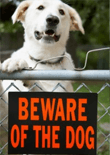
Dog Aggression Training, Understanding Your Dog.
By Sally Gutteridge | Behavior , Posts
 A dog that shows signs of aggression can become a problem within a family environment; therefore any dog owner should have a basic understanding of why and how a dog can become aggressive.
If your dog has suddenly developed aggressive behavior it is paramount that he is checked by a Veterinarian to rule out any physical reason for his behavior change.
If a fearful dog feels threatened and unable to remove himself from the threat then he may resort to aggression as a defensive behavior. This can progress, over time, to the point of an aggressive reaction before the perceived threat is even apparent to the human eye.
A dog who has learned that aggression provides the result he would like may resort to a threatening growl or bark purely as a learned behavior. An example of this is food or resource guarding. Although guarding behavior this can also be based in fear, the fear of losing a needed resource.
The behavior of any dog will respond to the circumstance he is in. Different dog breeds have differing levels of reaction. Some breeds will not resort to aggressive stance or behavior until the absolute last resort whereas others will seem to become aggressive immediately on contact with a trigger circumstance. Successful dog aggression training will modify the dog’s immediate response to the trigger.
External signs of aggression
The early signs of aggression can easily be missed by an unaware owner. This is usually what happens when a dog is reported to have bitten with no warning.
The following points are progressive and generic signs that an aggressive response is building within your dog. Calming signals may prelude this behavior which would include yawning, glancing away and attempting to leave the situation. This depends on how reliant on aggression the dog is to produce a result.
- Narrowing of eyes
- Shifting of body weight
- Raising of tail (The dog with a docked tail can struggle with communication)
- Raising of hackles
- Posturing to look bigger
- Growling
- Barking
- Air snapping
- Biting
Somewhere between posturing and biting the dog may show a slight freeze. This moment of being completely still is the dog’s natural fight or flight reaction. If the freeze is displayed and the dog cannot leave the situation he is likely to feel that he needs to bite next.
Trigger for aggressive behavior
Aggressive behavior displayed by your dog is almost always a response to a stimulant. Before commencing any type of dog aggression training it is vital to first recognize the dogs behavior and the external trigger that leads to it.
A trigger for aggressive behavior in a dog can be anything at all. It will depend on previous experiences and is usually based in fear or uncertainty. Some of the more common triggers and their possible learning processes are listed below.
- Dog aggression – Fear caused by under socialization or previous attack.
- People aggression- Fear caused by lack of social contact, often with children. Fear aggression with people can also be a result of abuse.
- Guarding behavior – Resource guarding, this can be learned. Or a response to past hunger or struggling for food, comfort or attention.
- Territorial aggression – Guarding the home, once again often learned. The excitement or fear response of visitors to the home can easily become reinforced. Certain breeds will as a natural response guard the home more than others.
Dog aggression training
If your dog is showing aggressive behavior, it is vital that by using positive and reward based conditioning that this behavior is changed. To modify any behavior type you will need to go deep into the roots of the problem, know exactly why the behavior is manifesting and treat the cause and not the symptoms, which in this case is the aggressive behavior.
Never confront a dog that is showing aggressive behavior. It is essential that the dog is not forced to carry out the behavior that he is threatening.
A behavior modification process for aggression will usually follow the stages below. Each dog will need slightly different handling depending on many factors including the dogs past, breed type and nature.
- Trigger recognition – Finding out what causes the behavior
- Observation – Watching the dog before he resorts to aggression. Noting the point of change in his body language.
- Modification – When observation is carried out a dog’s limits can be identified. For example aggression directed at another dog may only be displayed towards a dog within a range of a few meters. If this is the case modification can begin by working on keeping the dog relaxed whilst getting closer gradually to another dog. This can be done by rewarding calm behavior and increasing distance if aggressive behavior appears to be developing.
If carrying out dog aggression training is likely to put you, your dog or anyone else at risk it is imperative that you seek professional one on one advice from an established dog behaviorist or reputable positive dog trainer.
 Dog training games provide so much more than mental stimulation to your dog. They enable handler control and encourage the dog to focus. They build the relationship between you and your dog and bring the same relationship onto another level.
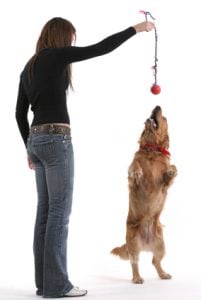 Basic dog training is not complicated. To train a dog is simply to teach him to do something. Dog training is often seen uniquely as teaching a dog to behave nicely, or do specific tricks to impress. What many people do not understand however is that is just as easy, if not easier, to train a dog to misbehave.
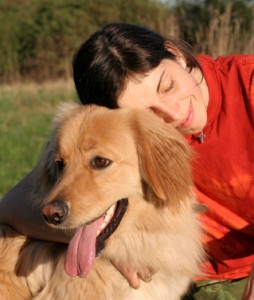 What is positive dog training? Is there such a thing as a positive or negative dog training?
 A saying used daily in many circles is “you can’t teach old dog’s new tricks”. This is simply not true. A dog of any age will learn when motivation and circumstance permits. A human being can obtain a higher degree whilst simultaneously drawing a pension. A middle aged or elderly dog can learn equally well.
 The internet has opened up the world to us in so many ways. People can work alongside work colleagues regardless of location. Social networking has become a huge part of our lives and enables us to stay in touch easily and effectively. We can have face to face phone calls with friends and family on the other side of the globe and obtain a university degree and other top level qualifications by distance learning.
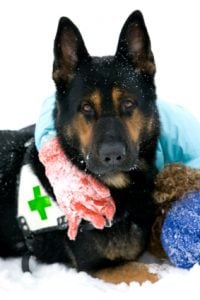 The Search and rescue dog team is an invaluable resource. Often working on a voluntary basis, handlers train their dog to find people that are lost, injured or at risk.
 Owning your first dog is an educational and enlightening experience. Each and every dog that you live with will teach you something new about the canine species.
 Deciding to offer a home to a dog is a big decision. You’ll be committing yourself to taking care of an animal for the rest of its life. The needs of any dog must be met consistently to ensure that this decision to have a dog works out perfectly. Exercise, mental stimulation with positive reinforcement and health requirements all need to be taken into account when working out how to choose a dog with success.
 The Therapy dog is a concept that has changed the lives of countless people.